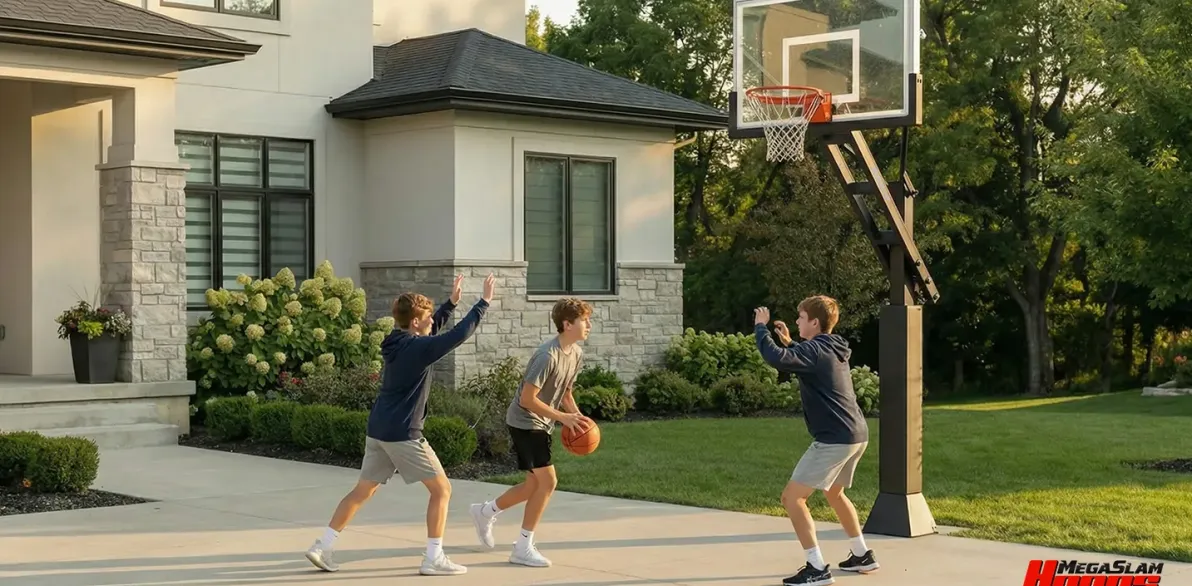
Not all basketball hoops are created equal, and buying the wrong one is an easy mistake to make. Choose a hoop that is too light and it wobbles every time you hit the backboard. Choose a portable system when you actually need something permanent, and you will be replacing it within a few seasons.
This basketball hoop buying guide walks you through everything that matters before you buy: hoop type, backboard size and material, pole strength, height adjustability, installation requirements, and budget. By the end, you will know exactly what to look for in a basketball hoop and which category fits your situation.
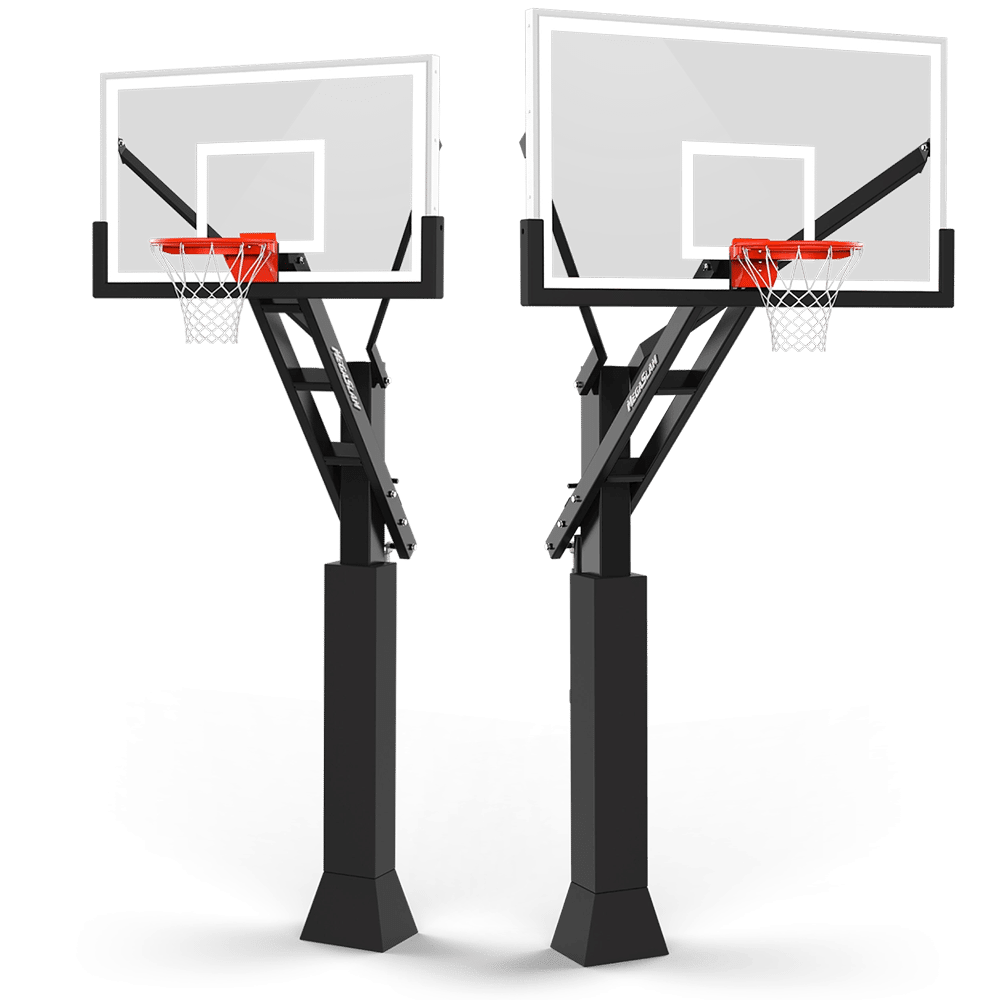
If you already know you want an in-ground system and just need to pick a model, jump ahead to our roundup of the best in-ground basketball hoop options. For buyers who want premium build quality, Mega Slam Hoops offers in-ground systems built for serious home use.
Understanding the Main Types of Basketball Hoops
Portable Hoops
Portable hoops sit on a weighted base (typically filled with sand or water) and can be moved around your driveway or yard. Setup is straightforward and requires no tools or concrete. The trade-off is stability: portable bases are prone to tipping on hard shots and the systems rarely support backboards larger than 54 inches. They may be the right choice for renters, young children, or anyone who needs a hoop they can relocate.
In-Ground Hoops
In-ground hoops are anchored in concrete, typically 48 inches deep, which makes them the most stable option by a significant margin. They support larger backboards (up to 72 inches), have thicker poles, and regulation sized backboards, which is why serious home players and families who want a long-term setup almost always go this route. For a closer look at what separates the top models, see our guide to in-ground basketball hoops.
Portable vs In-Ground
| Portable | In-Ground | |
|---|---|---|
| Setup | No tools, fill base with sand/water | Dig hole, pour concrete; pro install recommended |
| Cost Range | $350-$600 | $1,500-$3,000+ |
| Durability | Fair; base can tip or crack | Excellent; anchored permanently |
| Best For | Renters, beginners, kids | Serious home players, families |
Key Factors to Consider When Choosing a Basketball Hoop
1. Backboard Size and Material
Backboard width has a direct effect on play quality. A 48-inch board is fine for younger kids, but for serious shooting practice or family games, 54 inches is the minimum worth considering. At 60 to 72 inches, you get a backboard close to regulation size, which improves bank shots and gives players more surface to work with.
Material matters just as much as size. Tempered glass delivers the best rebound response and is what you find on professional courts. Acrylic is a solid mid-range choice: lighter than glass and more impact-resistant, with good-enough rebound performance for most home players.
2. Pole Type and Thickness
Most in-ground hoops use a single-pole design, which is the standard for residential systems.
Pole diameter is the key spec to check. A 5-inch or 6-inch pole is where vibration becomes essentially a non-issue. If you want the backboard to behave the way it does on a proper court, prioritize pole thickness. The Mega Slam 72 has an 8” x 6” pole while the larger Mega Slam XL boasts an industry-leading 12” x 8” pole.
3. Adjustability and Height Range
NBA and FIBA regulation rim height is 10 feet. If everyone in your household is an adult who plays at that height, adjustability may not be a priority. For families with younger players, an adjustment system that moves the rim from around 5 feet up to 10 feet is genuinely useful and makes the hoop work for players at every stage.
4. Rim Type
A breakaway rim uses a spring-loaded hinge that flexes under load, which reduces stress on the backboard and is safer for players who dunk. For anyone who goes up strong, a breakaway rim is worth the extra cost in a high end in-ground basketball system.
Whatever type you choose, check that the rim is made from solid steel and that it has a stated weight rating. Cheap rims bend under repeated use and lose their shape, which affects shooting accuracy and looks poor.
5. Installation Requirements
In-ground hoops require digging a hole 48 inches deep, inserting anchor bolts, and pouring concrete. The concrete needs 72 hours to cure before the pole and backboard can be attached, and the system should not be played on until the footing is fully set. For most homeowners, professional installation is the right call: a misaligned or under-depth anchor is difficult and expensive to correct once the concrete sets. Factor installation into your total basketball hoop cost when budgeting.
6. Weather Resistance and Durability
If your hoop is outside year-round (and it will be), material quality matters. Look for powder-coated galvanized steel on the pole and extension arm, which resists rust and holds its finish through cold winters and wet seasons. Backboards should be UV-resistant so they do not yellow or delaminate after a few summers of sun exposure. Tempered glass and quality acrylic both hold up well outdoors; cheap polycarbonate boards can warp over time.
A warranty is a useful indicator of how much confidence a manufacturer has in their product. Premium in-ground systems from brands like Mega Slam Hoops come with multi-year warranties that cover structural components.
7. Budget Considerations
Here is a straightforward breakdown of what different price points get you. Keep in mind that installation is a separate cost for in-ground systems, typically adding $500 to $1,200+ depending on your area. For a full breakdown, see our article on basketball hoop cost. You can also compare basketball hoop brands to see how the major manufacturers stack up on price and quality.
| Price Range | Hoop Type | Features Included | Best Use Case |
|---|---|---|---|
| Under $500 | Portable | Basic acrylic or polycarbonate board, fixed or manual height adjust | Casual play, young kids, renters |
| $500-$1,500 | Mid-range in-ground | Acrylic backboard, 3.5-inch pole, crank height adjust | Recreational family play |
| $1,500-$3,000+ | Premium in-ground | Tempered glass board, 5-6 inch pole, pneumatic/crank adjust, warranty | Serious players, daily use |
How to Choose a Basketball Hoop for Kids vs Adults
For Kids Under 12
Young players need a hoop that can be set at lower heights (6 to 8 feet) so they can develop proper shooting form without compensating for a rim that is too high. An adjustable system is essential here. For this age group, a mid-range portable or a lower-cost in-ground with a wide adjustment range works well. The backboard does not need to be large, but it should be durable enough to handle years of use as the child grows.
For Teens and Adults
Teens who are playing competitively or training regularly will benefit from a regulation-height in-ground hoop with a backboard of at least 54 inches, and ideally 60 to 72 inches. At this level, the rebound response of the backboard and the rigidity of the pole start to matter for realistic practice. A tempered glass board on a minimum 6-inch pole is the right target spec for a serious teenage or adult player.
For households with both young children and adults, a premium adjustable in-ground system covers all bases. Set it low for the kids, crank it to 10 feet for the adults, and it will last the household for many years.
Frequently Asked Questions
What size backboard should I get for a home basketball hoop?
For casual or recreational play, a 54-inch backboard is a reasonable starting point. If you are playing competitively or want the most realistic experience, go for 60 to 72 inches. Younger children are fine with a 54-inch board, but they will outgrow it quickly if they play regularly.
How long does it take to install an in-ground basketball hoop?
The physical work of digging the hole, setting the anchor sleeve, and pouring concrete typically takes a few hours. After that, the concrete needs 72 hours to cure before you can attach the pole and backboard. Factor in a few more hours for assembly, and most installations are complete and ready to play within three to four days of starting.
Is an in-ground basketball hoop worth it?
If you plan to play regularly and want a setup that performs and lasts, yes. In-ground hoops eliminate the flex and instability of portable systems, support larger backboards, and do not need to be stored during bad weather. The upfront cost is higher, but the durability and play quality make it the better investment for any serious home player or active family.
Conclusion and Next Steps
Choosing the right basketball hoop comes down to four things: how much stability you need, what size and material backboard suits your game, how important height adjustability is for your household, and what your total budget is including installation. In-ground systems deliver the best long-term performance, and if you are buying for serious play, they are worth the extra upfront investment.
Mega Slam Hoops offers a range of premium in-ground basketball hoops designed for serious home players and active families. Browse our range of in-ground basketball hoops to find the right fit for your home.