Getting the surface wrong is one of the most expensive mistakes you can make when building a court. Replacing cracked pavement, correcting drainage problems, or tearing out an underperforming surface can cost far more than choosing the right basketball court flooring from the beginning.
For most backyard builds, interlocking court tiles over a concrete base give you the best combination of performance, safety, and installation flexibility. They provide sport-specific playability, reduce joint stress compared to bare concrete, and can often be installed without specialized contractors.
So what is the best surface and flooring for a backyard basketball court? For most homeowners, the answer is a properly prepared concrete base topped with quality interlocking sport tiles. In this guide, you’ll see an honest comparison of every major surface option, including concrete, asphalt, coatings, rubber flooring, and basketball court tiles.
Backyard Basketball Court Surfaces at a Glance
| Surface Type | Cost (Low/Mid/High) | Durability | Joint Impact | DIY Friendly | Best For |
|---|---|---|---|---|---|
| Concrete | Medium | High | High | No | Permanent court foundations |
| Asphalt | Low | Medium | Medium | No | Budget-conscious builds |
| Interlocking Tiles | Medium-High | High | Low | Yes | Most backyard courts |
| Acrylic Coating | Medium | Medium-High | Medium | No | Upgrading existing surfaces |
| Rubber Flooring | High | Medium | Low | Yes | Indoor or covered spaces |
If you’re planning a new court today, the strongest long-term combination is a concrete foundation with a sport tile surface on top. It provides durability underneath and player comfort above.
Concrete
Concrete serves as the foundation for most residential basketball courts for one simple reason: it lasts.
A properly installed concrete slab creates a stable, level base that can support decades of basketball use with minimal maintenance. Most residential court installations begin with concrete, regardless of what surface material is ultimately installed above it.
The downside is hardness.
Bare concrete provides very little impact absorption. Every jump, sprint, and change of direction transfers force directly into your ankles, knees, and hips. For younger players this may be manageable, but extended play sessions can become noticeably more demanding on your joints.
Drainage is another important consideration. Concrete courts should include approximately a 1% to 2% slope to prevent standing water and surface pooling after rain. In terms of longevity, concrete can often last 20 to 30 years with limited maintenance when installed correctly.
Typical installed cost ranges from $3 – $8 per square foot.
Best use case: Permanent backyard courts where long-term durability matters and you plan to install sport tiles or a coating system over the slab.
Asphalt
Asphalt remains a popular alternative for homeowners looking to reduce upfront construction costs.
Because asphalt contains bitumen, it offers slightly more flexibility and shock absorption than concrete. While the difference is not dramatic, many players notice a somewhat softer feel underfoot.
Drainage is another advantage. Asphalt surfaces naturally shed water effectively when properly graded.
However, asphalt has several drawbacks that become particularly relevant in hot climates such as Texas.
High summer temperatures can soften the surface, making it more vulnerable to scuffing, deformation, and wear. Over time, seasonal temperature changes can also contribute to cracking and surface deterioration.
While asphalt generally costs less initially than concrete, maintenance requirements tend to be higher over the long term.
Typical installed costs range from $3 – $5 per square foot.
Best use case: Cost-conscious backyard courts in moderate climates where minimizing initial construction expenses is a priority.
Interlocking Court Tiles
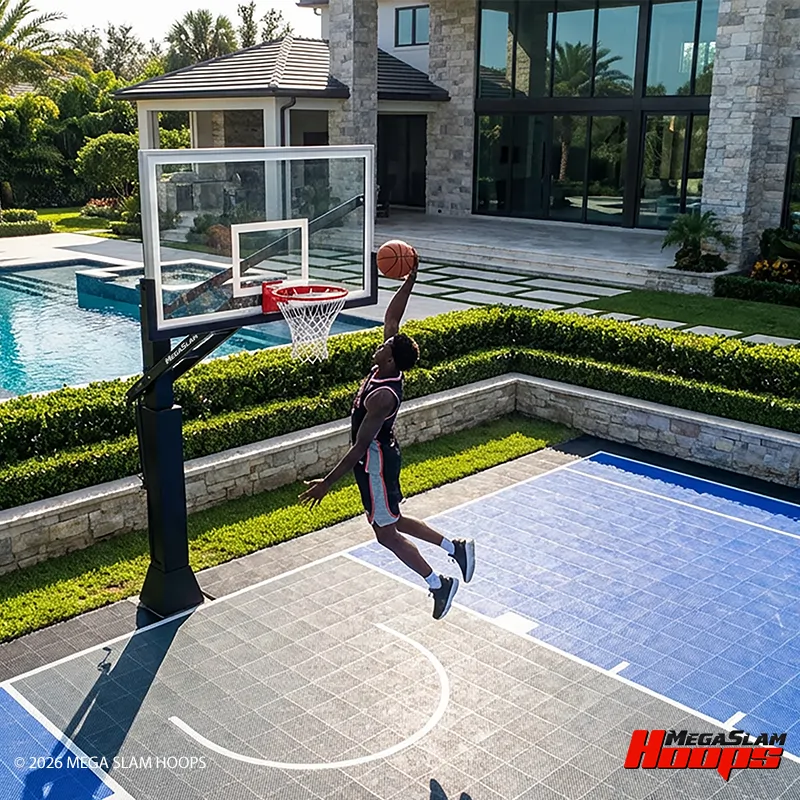
Interlocking court tiles are the surface recommended for most backyard basketball courts.
These modular polypropylene panels snap together over an existing concrete or asphalt base to create a dedicated sports surface designed specifically for athletic performance. Unlike bare pavement, quality sport tiles include a suspension system beneath the playing surface. This design absorbs impact, reduces stress on joints, and creates a noticeably more comfortable playing experience.
Ball response is another major advantage. Properly engineered basketball court tiles provide consistent bounce characteristics that closely resemble competitive playing environments.
Installation is often straightforward enough for motivated homeowners to complete themselves. Because the tiles simply connect together, many backyard projects can be installed over a weekend without specialized surfacing contractors.
Drainage performance is excellent. Water passes through the gaps between tiles and drains below the surface rather than collecting in puddles. This often allows the court to become playable again more quickly after rainfall.
Flexibility is another benefit that is often overlooked. If you decide to expand your court, relocate sections, or modify your layout later, tiles can usually be removed and reconfigured without demolishing the entire surface.
Typical costs range from $3 – $8 per square foot. If you’re installing the tiles yourself, you may also avoid significant labor expenses associated with specialty surfacing systems.
For homeowners still planning the overall project, review our planning your backyard court guide.
Best use case: Nearly every backyard basketball court, especially installations built over existing concrete slabs.
Acrylic Coatings
Acrylic coatings are commonly applied over concrete or asphalt to improve playability and appearance.
These coatings add traction, reduce surface glare, and create the colored finish most people associate with professional outdoor courts. They also provide the foundation for painted court lines and custom graphics.
Compared to bare pavement, coated surfaces generally feel more comfortable and offer improved grip during play.
However, coatings are not permanent. Depending on traffic levels, weather exposure, and local climate conditions, resurfacing may be required every 5 to 10 years. Professional application is typically recommended to achieve proper adhesion, consistent texture, and long-term durability.
Typical costs range from $1.50 – $3.50 per square foot.
Best use case: Upgrading an existing concrete or asphalt surface when you want improved aesthetics and traction without installing a tile system.
Rubber Flooring
Rubber flooring provides the greatest impact absorption of any surface discussed in this guide.
For joint comfort alone, it performs extremely well. Running, jumping, and landing generally feel softer than on concrete, asphalt, or coated surfaces.
That does not mean it is the best choice for an outdoor basketball court.
Rubber flooring can struggle with UV exposure, heat retention, and drainage. In direct sunlight, outdoor rubber surfaces may become uncomfortably hot, and long-term weather exposure can accelerate degradation.
For that reason, rubber is usually better suited to indoor facilities, covered training spaces, or small shooting areas rather than full outdoor courts.
Some homeowners use rubber flooring for dedicated training stations or fitness zones adjacent to a court.
Best use case: Indoor or covered basketball spaces where comfort is the highest priority.
Basketball Court Paint and Line Marking
Surface markings play a functional role and a visual one.
The primary purpose of basketball court paint is to create clearly defined boundaries, key areas, free-throw lanes, three-point arcs, and center court markings. Paint can also be used to separate multiple sports on a shared recreational surface.
For outdoor applications, acrylic court paint is generally considered the industry standard. It is designed to withstand UV exposure, foot traffic, and changing weather conditions.
Standard exterior house paint is not intended for sports surfaces and typically wears out much faster under athletic use.
Most paint systems are applied over an acrylic coating layer, which helps improve adhesion and durability.
For smaller backyard courts, many homeowners successfully complete line marking themselves using measuring tapes, chalk lines, and masking tape. Regulation layouts, however, often benefit from professional marking services because even small measurement errors become noticeable during play.
For multi-sport courts, use different line colors for different activities. White is commonly used for basketball, while yellow or other contrasting colors can designate pickleball, tennis, or additional games.
Properly executed court markings contribute significantly to the finished appearance of the court.
Which Surface Is Right for Your Backyard Court?
If you already have a concrete slab, install interlocking tiles or apply a sport coating.
If you’re building from scratch, pour a concrete base and install sport tiles on top. This creates the most versatile and future-proof solution available.
If budget is your primary concern, asphalt remains a functional starting point and can still provide years of recreational use.
If you’re building an indoor or covered facility, rubber flooring deserves consideration for its joint-friendly characteristics.
For most homeowners, the best overall solution is clear: a concrete foundation combined with interlocking court tiles. You gain the durability of concrete, the performance benefits of a sports surface, improved drainage, reduced joint impact, and the flexibility to modify the court later if your needs change.
Frequently Asked Questions
How much does it cost to surface a backyard basketball court?
Surface costs vary significantly based on material selection and court size. Expect costs ranging from $1.50 – $8 per square foot depending on whether you choose coatings, tiles, asphalt, or concrete.
Can you put basketball court tiles over grass?
No. Basketball court tiles require a stable base such as concrete or asphalt. Installing directly over grass will result in movement, uneven surfaces, and poor performance.
How long do interlocking court tiles last?
Quality sport tiles can last many years under normal residential use. Lifespan depends on climate, UV exposure, maintenance, and product quality.
What paint do you use on an outdoor basketball court?
Acrylic court paint is generally the economical choice for outdoor courts. It provides durability, UV resistance, and consistent traction compared to ordinary exterior paints.
Do basketball court tiles affect ball bounce?
Yes, but quality basketball court tiles are engineered to maintain consistent and predictable ball response. Properly designed tiles provide excellent playability while also improving comfort.
Building a great court starts from the ground up. While every surface option has strengths, interlocking sport tiles installed over a properly prepared concrete base provide the best overall balance of performance, durability, comfort, and flexibility for most homeowners. If you’re still evaluating your overall project, read our full guide to building a backyard basketball court. When you’re ready to complete the court with a premium in-ground hoop, explore Mega Slam Hoops systems.