The benefits of playing basketball reach far beyond the scoreboard. Few sports ask your body to sprint, jump, cut, and think at the same time, which is exactly why basketball builds cardiovascular endurance, coordination, strength, and mental focus in a single session. If you’re wondering what the proven physical and mental health benefits of playing basketball actually are, the evidence is substantial: regular play improves heart health, builds functional strength, sharpens decision-making under pressure, and supports emotional resilience. Whether you’re shooting free throws in your driveway or running full-court games with friends, the physical and cognitive demands of basketball make it one of the most complete forms of exercise available.

Physical Benefits of Playing Basketball
Basketball is built around short, repeated bursts of sprinting, followed by quick direction changes and brief recovery windows. This start-stop pattern mirrors high-intensity interval training, which is one of the most effective ways to improve aerobic capacity and heart health. Your heart rate spikes during a fast break and drops during a free-throw stoppage, then spikes again, training your cardiovascular system to recover faster over time.
This intensity also answers a common question: how many calories does basketball burn? A typical recreational game burns 600-800 calories per hour, depending on your body weight and how hard you’re playing. That output compares favorably to a steady jog, because basketball’s mix of sprinting, jumping, and lateral movement recruits more muscle groups than running in a straight line.
Every jump shot, box-out, and defensive slide asks something different of your muscles. Jumping repeatedly builds explosive power in your calves, quads, and glutes. Cutting and pivoting strengthen the stabilizing muscles around your knees and ankles. Boxing out and absorbing contact under the basket build core stability, while passing and shooting develop upper body coordination you don’t get from most cardio-only workouts.
Dribbling a ball while moving, reading defenders, and adjusting your body mid-air all require your brain and body to communicate constantly. This kind of hand-eye coordination and spatial awareness doesn’t stay on the court. It carries over into other sports and everyday movement, which is part of why basketball is often recommended as a base sport for young athletes.
Basketball is also a weight-bearing, high-impact activity, and that impact matters. Repeated jumping and landing place controlled stress on your bones, which stimulates bone density over time. This is especially important for growing children and adolescents, whose bones respond strongly to impact activity during peak development years.
Mental Health Benefits of Playing Basketball
Physical activity lowers cortisol, the hormone most associated with chronic stress, and basketball adds a second layer of benefit: it’s social. Playing with others, even in a casual pickup game, combines exercise with human connection, which compounds the stress-relieving effect of movement alone.

A basketball possession happens in seconds. You have to read the defense, judge distance and angle, and decide whether to shoot, pass, or drive, all while moving. That kind of rapid decision-making under time pressure is cognitively demanding, and some sports science research on youth participation suggests a link to improved attention and academic performance in children.
Hitting a shot that you’ve been working on, or making the right read in a game situation, builds a specific kind of confidence that comes from visible skill development. That confidence tends to transfer beyond the court.
Basketball also involves a lot of failure. Missed shots, blown defensive assignments, and turnovers happen to everyone, every game. Because the stakes of any single miss are low, basketball becomes a low-risk way to practice trying again immediately after failing, a habit that builds real mental resilience over time.
Is Basketball Good Exercise?
Is basketball good exercise? Yes, and the way it’s structured is a big part of why. Basketball naturally breaks into short bursts of high-intensity effort followed by brief recovery, which gives you a cardiovascular benefit comparable to formal interval training, without needing a stopwatch or a plan.
It’s also a full-body workout. Your upper body handles passing and shooting, your core stabilizes every jump and landing, and your lower body generates the explosive power behind driving and rebounding. Few single activities engage that much of your body in one session.
The social element matters too. People tend to play harder in a game than they do alone on a treadmill, because competition and teammates push effort levels up without you having to think about it.
You don’t need a full game to benefit. Shooting alone for 30 minutes, working on your handle, or running through a shooting routine in your driveway is still a meaningful workout on its own.
Benefits of Playing Basketball for Kids
Basketball gives kids more than just exercise. Learning to dribble, pass, and shoot develops fundamental movement patterns, coordination, and balance that support athletic development in general, not just on the court.
Team play teaches communication and cooperation in a way that’s hard to replicate elsewhere. Kids learn to call for the ball, set up teammates, and work toward a shared goal, skills that extend well past sports.
There’s also the screen-time factor. Every hour spent shooting hoops in the driveway is an hour of outdoor, active play competing directly with passive screen time, and that trade-off matters for long-term health.
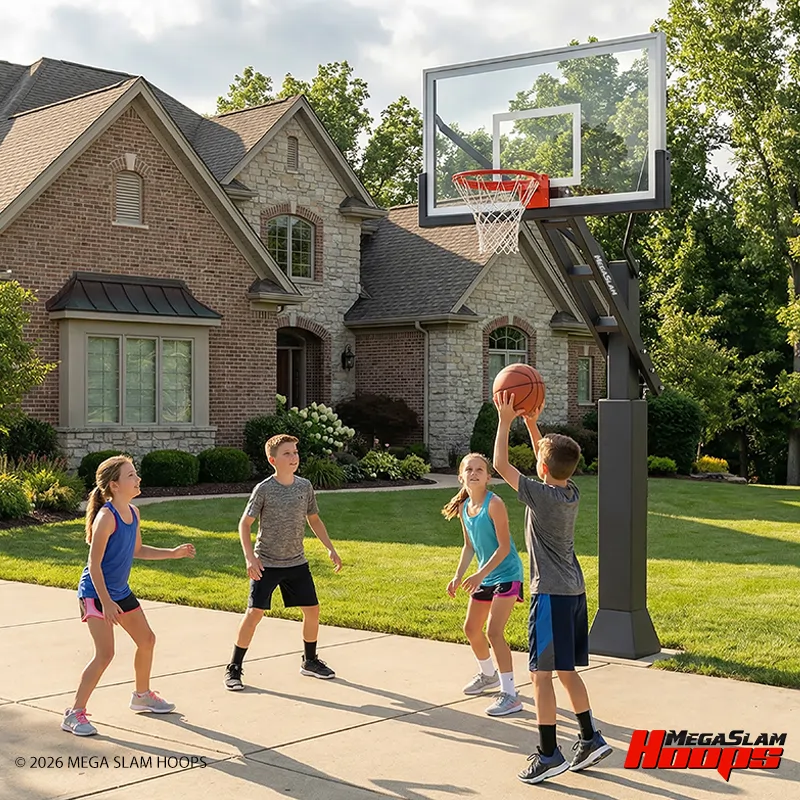
Kids who play sports when they’re young are more likely to stay physically active as adults, which makes basketball less of a phase and more of a foundation. And when a hoop is right in the driveway, none of this requires a scheduled practice or a drive across town. If you’re weighing your options, this guide to the best basketball hoops for kids and families breaks down what to look for.
How Much Basketball Should You Play?
For adults, the CDC recommends 150 minutes of moderate aerobic activity per week, and a couple of recreational games easily covers that. For kids, the standard recommendation is 60 minutes of active play per day, and a backyard hoop makes that achievable on an ordinary school day without needing to schedule anything.
Even 20 to 30 minutes of shooting drills counts as a meaningful workout. You don’t need a full game or a gym membership to get the cardiovascular and strength benefits basketball offers. If you’re ready to make that kind of daily activity easier to reach, Mega Slam Hoops systems are built for exactly that: consistent, low-friction practice time right where you live.
Frequently Asked Questions
What muscles does basketball work?
Basketball works your legs, glutes, and core through jumping and cutting, your shoulders and arms through shooting and passing, and your stabilizing muscles through defensive movement and quick direction changes.
How many calories do you burn playing basketball for 30 minutes?
A 30-minute session typically burns roughly half of the 600-800 calories burned in a full hour, depending on your body weight and how intensely you’re playing.
Is basketball good for weight loss?
Basketball can support weight loss because it combines cardiovascular exercise with strength-building movement, which helps burn calories during play and build muscle that supports your metabolism over time. Results depend on consistency and overall diet.
What are the social benefits of playing basketball?
Basketball builds communication, teamwork, and cooperation skills through team play, and the social connection of playing with others adds a mental health benefit that solo exercise doesn’t provide.