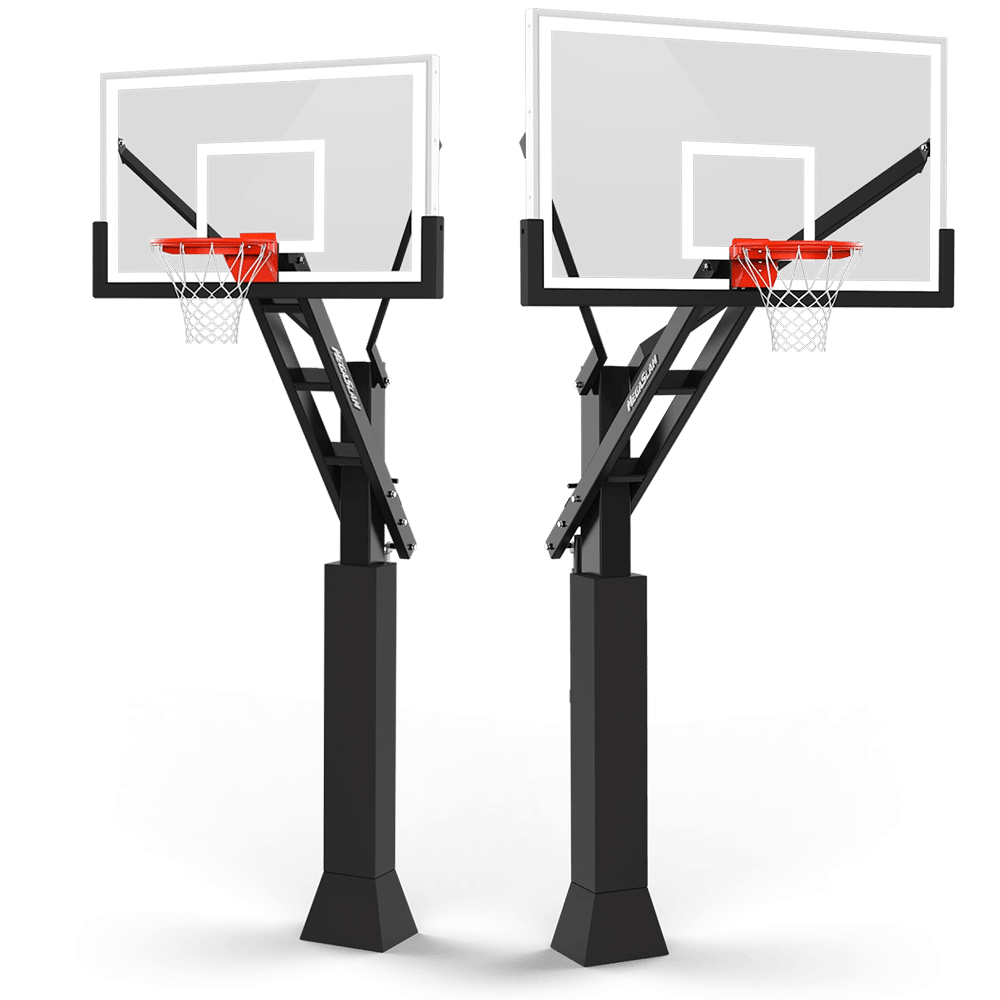
Basketball court dimensions change by level of play, and getting the numbers right matters when you’re marking free throw lines on a driveway or planning a full backyard build. This guide covers official court dimensions from the NBA down to recreational play, then translates those numbers into practical backyard planning guidance. Need the numbers fast? Start with the quick-reference table below.
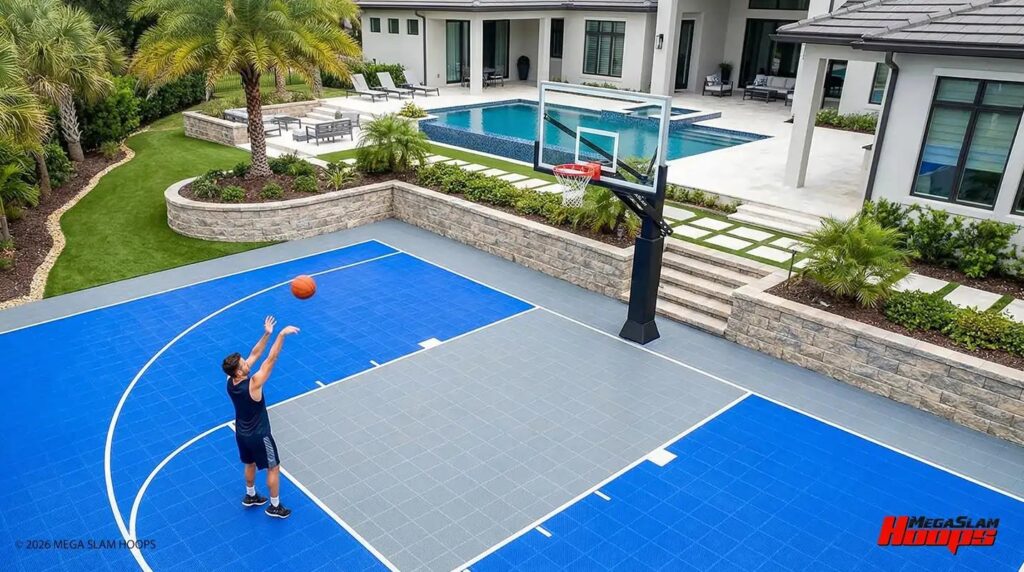
Quick Reference: Basketball Court Dimensions by Level
| Level | Full Court | Half Court | Three-Point Line |
|---|---|---|---|
| NBA | 94 ft x 50 ft | 47 ft x 50 ft | 23 ft 9 in (22 ft in corners) |
| NCAA (College) | 94 ft x 50 ft | 47 ft x 50 ft | 22 ft |
| High School | 84 ft x 50 ft | 42 ft x 50 ft | 19 ft 9 in |
| Recreational (typical) | 74 ft x 42 ft | 37 ft x 42 ft | Varies by facility |
Note: recreational court dimensions vary by facility since there’s no single governing standard.
Standard Full Court Dimensions
NBA Full Court Dimensions
An official NBA court measures 94 ft x 50 ft (28.65m x 15.24m). Within that footprint, a handful of markings define the game:
- Three-point arc: 23 ft 9 in from the basket, tightening to 22 ft in the corners
- Free throw line: 15 ft from the backboard
- Lane (key) width: 16 ft
These are the numbers to work from if you’re building a full-size court and want true NBA spacing.
NCAA (College) Full Court Dimensions
NCAA courts share the same 94 ft x 50 ft overall footprint as the NBA. The key difference is the three-point line: NCAA sets it at 22 ft, compared to the NBA’s 23 ft 9 in. If you’re painting your own court and want to reference college-level spacing, this is the number that changes. Everything else, including the free throw line and lane width, follows the same layout as the NBA.
High School Full Court Dimensions
High school courts measure 84 ft x 50 ft, ten feet shorter than NBA and NCAA courts but the same width. The three-point line sits at 19 ft 9 in. Because the footprint is smaller and easier to fit on a residential lot, high school dimensions are the most commonly referenced standard when homeowners build a full backyard court.
Recreational Full Court Dimensions
Recreational courts, the kind you’ll find at community parks or informal facilities, typically measure around 74 ft x 42 ft. There’s no governing body setting this standard, so actual dimensions vary from one facility to the next. Treat these numbers as a general reference rather than a fixed spec.
Half Court Basketball Dimensions
Standard Half Court Size
A half court is simply half the length of a full court, measured from the baseline to the half-court line. An NBA half court works out to 47 ft x 50 ft. For residential builds, most homeowners work from high school half court specs instead: 42 ft x 50 ft.
Half courts are far more practical for a home build, and they sacrifice very little in terms of real gameplay. You still get full-width shooting angles, a complete three-point arc, and room for competitive one-on-one or small pickup games, all in roughly half the footprint of a full court.
How Much Space Do You Actually Need?
The court dimensions above only cover painted lines. In practice, you also need out-of-bounds buffer space: 3 to 5 ft of clearance on each side of the court and behind the baseline, so players aren’t running full speed into a fence or retaining wall.
Working from a high school half court (42 ft x 50 ft) with a 4 ft buffer on each side and behind the baseline, the minimum realistic outdoor footprint comes out to 46 ft x 58 ft. That’s the number to plan around if you want a genuinely playable half court, not just one that technically fits the painted lines.
Key Court Markings Explained
If you’re planning to paint your own court, here’s what each marking is and why it’s there:
- Three-point arc: The curved line defining shots worth three points. Distance from the basket varies by level, as covered above.
- Free throw line: A straight line 15 ft from the backboard where players shoot free throws after a foul.
- The lane (key/paint): The rectangular area under the basket, 16 ft wide at NBA and NCAA level, that limits how long an offensive player can stand near the basket.
- Center circle: The circle at midcourt used for the opening jump ball. It’s only relevant on a full court, not a half court build.
- Restricted area: A small semicircle under the basket where defenders can’t draw a charging foul. It’s a nice-to-have for accuracy but not essential on a backyard court.
Basketball Court Dimensions for Backyard Courts
Minimum Space Recommendations
For a half court that’s actually enjoyable to play on, plan for a minimum footprint of 30 ft x 50 ft. That accounts for a regulation 3-point line, free throw line and lane markings. Going smaller is possible, but it starts to cut into buffer space and makes fast breaks and full-speed layups feel cramped.
How to Plan Your Backyard Court
Start by measuring your available space, length and width, and note any fixed obstacles like fences, trees, or utility lines. From there, work backward from the dimension tables above to land on the largest court size that realistically fits with proper buffer space.
A few other decisions worth making early:
- Surface type: concrete, asphalt, or a modular sport tile system, each with different cost and maintenance tradeoffs
- Hoop type: in-ground systems offer the stability and consistent rim height that a serious backyard court calls for, compared to portable bases that can shift under regular play
- Court orientation: where possible, orient the court north-south rather than east-west. This minimizes sun glare at shooting angles during morning and evening play
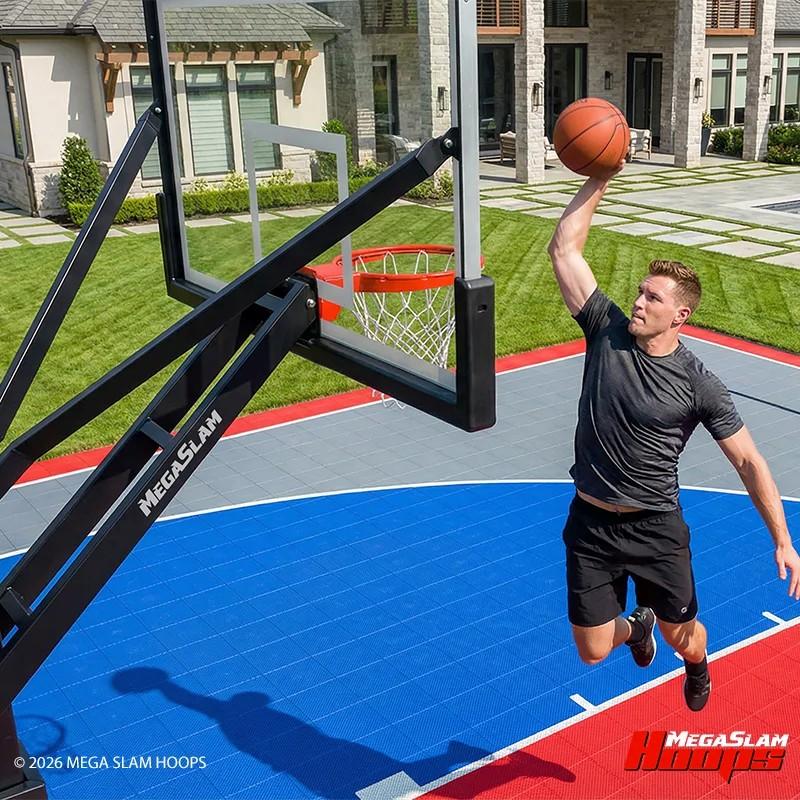
For anyone building a court meant for real practice and not just casual shooting, the hoop matters as much as the court itself. Mega Slam’s in-ground basketball systems are built for exactly this kind of setup, with the stability to handle daily use at true rim height.
For a full breakdown of what a backyard court costs to build, see our guide on backyard basketball court costs. For the complete official dimension reference this article supports, visit Court Dimensions.
Ready to Build?
Now that you know your dimensions, the next step is finding the right hoop. Explore Mega Slam’s in-ground basketball systems, built to perform on courts just like yours.