A backyard basketball court can run between $10,000 and $100,000 installed, with most residential builds landing around $30,000. That’s a wide spread, and the reason is simple. Four variables move the number more than anything else: court size, surface material, how much work your ground needs before anyone pours anything, and where you live.
This guide breaks down each of those cost drivers with real figures, so you can build a budget that holds up instead of one that doubles halfway through the project. Whether you’re planning a full from-scratch build or just upgrading an existing driveway or slab, the same cost drivers apply.
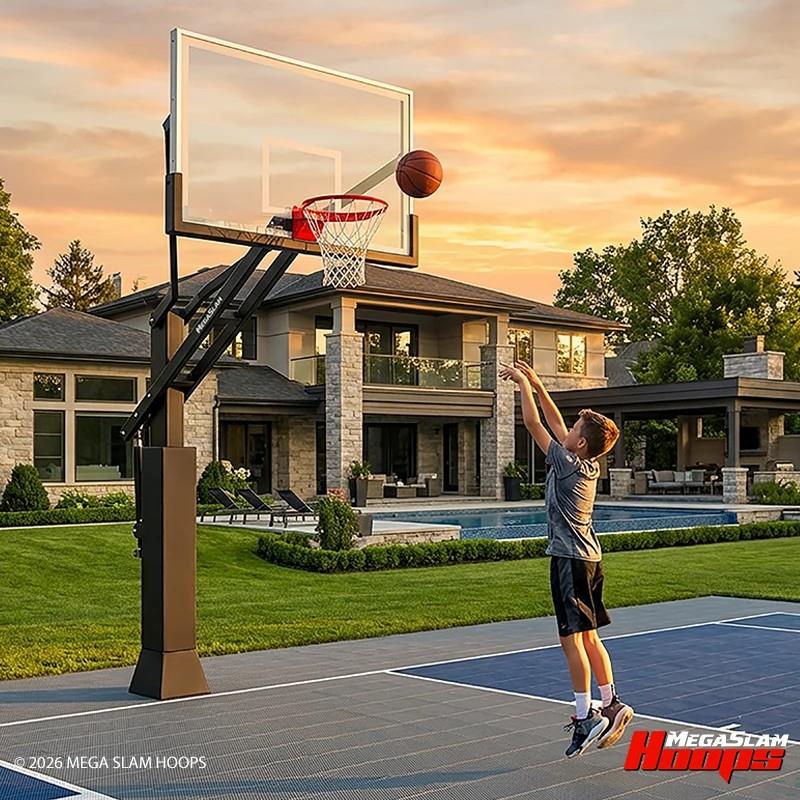
Average Backyard Basketball Court Cost
The biggest single factor in your total is square footage. Everything else scales off it: more surface means more concrete or asphalt material, more ground prep, and more labor. Before you pick a surface or worry about lighting, decide how much court you actually want.
Cost by Court Size
Most backyard builds are half courts, and for good reason. A half court gives you a key, a three-point line, and enough room for one-on-one, shooting drills, and small games without swallowing your entire yard or budget.
A regulation half court runs roughly 47 feet by 50 feet, about 2,350 square feet, though most residential half courts are scaled down to fit the space, often 30 by 50 or smaller. Expect an installed cost in the range of $18,000 – $30,000 depending on surface and prep. A flat lot with a modest half court and a painted concrete surface sits near the bottom of that range.
A full court is 94 feet by 50 feet, about 4,700 square feet, and the cost roughly doubles to the $75,000 – $100,000 range. Full courts also demand a much larger flat area, which is where ground prep costs tend to climb. This is where a sloped lot needing excavation pushes a build toward the top of the overall $10,000-$100,000 range. Unless you have the space, the budget, and a real reason to run full-court games, a half court delivers nearly all the playability for a fraction of the cost.
Cost by Surface Type
Concrete is the benchmark every other surface gets measured against, so start there. Concrete prices vary per square foot installed depending on location but usually run between $6 – $10 psf. It’s durable, low-maintenance, and the standard for permanent courts. The trade-off is a hard, unforgiving playing surface and the risk of cracking if it isn’t poured and reinforced correctly.
Asphalt runs roughly $3 – $5 psf, slightly cheaper than concrete up front. It’s a bit softer underfoot, but it degrades faster, needs resealing every few years, and softens in extreme heat, which matters in a Texas summer.
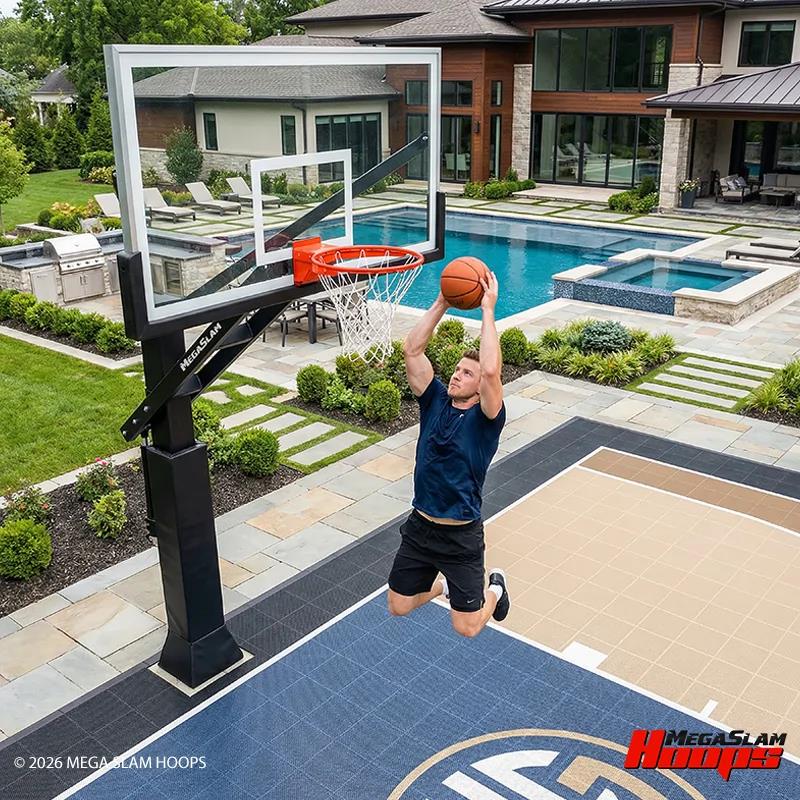
Modular sport tiles run roughly $4 – $8 psf, and installation is over a concrete or asphalt base, so it’s an added layer rather than a replacement. The tile flexes to cushion joints, drains well, and gives consistent ball bounce. It’s the premium option, and it costs accordingly.
Painted concrete is concrete with court lines and color coating added, roughly $1.50 – $3.00 psf on top of the slab. It’s the most budget-friendly way to get a finished, court-ready look without the price of modular tile.
What Drives the Price Up
Two courts of the exact same size and location can differ by tens of thousands of dollars once you factor in surface choice, fencing, lighting, and ground conditions. Here’s where that money goes.
Surface Material
The concrete-versus-tile decision is the one most worth thinking through. Premium modular tile is worth the additional cost when joint comfort matters, when you’re playing frequently, or when you want the best possible bounce and traction. It’s also a smart choice for players with knee or ankle concerns, since the cushioned surface is far easier on the body than bare concrete.
Painted concrete is the smarter choice when budget is the priority, when the court sees lighter use, or when you’d rather put the savings toward other parts of the build. A well-finished painted concrete court plays perfectly well and lasts decades. You’re not cutting a corner by choosing it; you’re choosing a different balance of cost and feel.
Ground Preparation and Leveling
This is the cost that surprises people most. A basketball court needs a flat, stable, properly drained base, and very few backyards start out that way. If your lot slopes or has soft soil, you’re paying for excavation, grading, and sometimes a retaining wall or added base material before the surface ever goes down.
On a level lot with good soil, prep might add $1,500 – $3,500. On a sloped or problem lot, grading and excavation can add $2,500 – $7,500 or more, occasionally rivaling the cost of the surface itself. Get your site evaluated early. The condition of your ground can shift your entire budget, and it’s the one number you can’t eyeball from a lawn chair.
Fencing and Lighting
Both fencing and lighting are optional; however, most court owners appreciate having them. Fencing keeps balls in and adds a finished look, running roughly $3,500 – $15,000 depending on height, material, and how much of the court you enclose. A full perimeter containment fence costs considerably more than a single backstop behind the hoop.
Lighting extends play into the evening, and each light pole runs roughly $1,800 – $2,500 installed, depending on fixture quality and whether you need new electrical runs to the court. Pole-mounted LED fixtures are the common choice for even, glare-controlled coverage.
Permits and HOA Rules
Permits vary widely by municipality. A simple surface install in a rural area may need nothing, while a build with structures, electrical, or drainage changes in a city can run $500 – $1,500 in permit fees. Check with your local building department before you commit to a design.
HOA rules trip up more homeowners than permits do. Many associations restrict court size, surface color, fence height, hoop placement, and lighting hours, and some prohibit permanent courts altogether. Read your covenants and bylaws before you spend a dollar — finding out after the slab is poured is an expensive way to learn the rules.
How to Save Money Without Cutting Corners
There’s a difference between saving money and creating future expenses, and a few choices land firmly on the smart side.
Choose concrete over asphalt
The slightly higher up-front cost pays for itself in durability and far lower maintenance over the life of the court. Asphalt’s resealing schedule erases its initial savings within a few years.
Build a half-court if space is tight
You give up almost nothing in everyday playability and save thousands in surface, prep, and materials. Most families never miss the second half.
Get at least three contractor quotes
Court build pricing varies a lot between contractors, and quotes give you both leverage and a clearer picture of what’s reasonable in your area. Make sure each quote covers the same scope, especially ground prep.
Avoid cheap modular tile knockoffs
Low-grade tile fades, warps, and loosens, and the replacement and maintenance costs surface long after the install looks done. If you want tile, buy quality tile. If quality tile is out of budget, painted concrete is the better value than a bargain alternative.
DIY vs. Professional Installation: Cost Comparison
DIY can save you a meaningful chunk of labor cost, but only on the parts you can genuinely do well. Be honest about which parts those are.
Pouring concrete is not a realistic DIY job for most homeowners. A court slab needs correct thickness, reinforcement, proper slope for drainage, and a clean finish, and mistakes are permanent and expensive to fix. Site grading and excavation are the same story: they require equipment and experience, and getting the base wrong undermines everything built on top of it. These belong to a licensed contractor.
What you can realistically DIY is the finishing work. Painting court lines, installing modular tile over a finished base, and setting up your hoop are all within reach for a handy homeowner with time. Doing the surface lines and hoop install yourself can shave some costs off a professional quote.
The practical path for most people is a hybrid: hire out the slab and grading, then handle the finishing details yourself. You capture real savings on the work that’s safe to DIY without gambling on the part that determines whether your court lasts twenty years or cracks in two.
Don’t Forget the Hoop
It’s easy to budget the surface, the prep, and the fence, then realize you never priced the one piece the whole court exists for. The hoop is a frequently overlooked line item, and it’s not a small one.
In-Ground Hoop Cost Overview
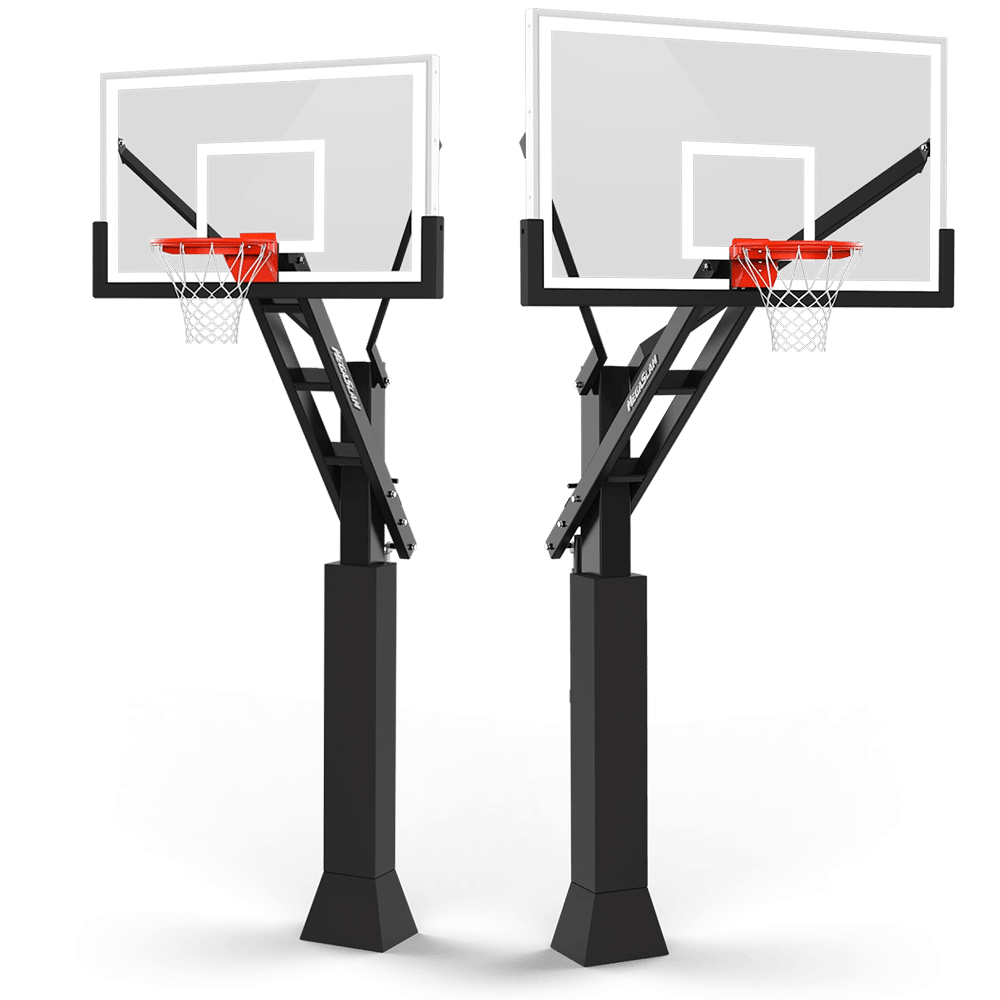
Premium in-ground hoops run $2,800 – $3,300 and up, built for stability, a true rebound off a full-size tempered glass backboard, and decades of outdoor use.
This is where it pays to match the hoop to the court you just built. If you’ve invested in a quality surface, a flimsy hoop undercuts the whole setup. Mega Slam’s in-ground hoop range is engineered for serious, long-term backyard play, with the pole strength and backboard quality that hold up to daily use and weather. After spending on a court built to last, a premium hoop is the piece that makes it feel and play like the real thing.
Is a Backyard Court Worth the Investment?
For most families who build one, yes, though the return shows up in more than one form.
The everyday value is the obvious one. A backyard court turns idle yard space into the place your kids and their friends actually want to be, year after year. It pulls people outside and off screens, and it’s available the moment anyone wants to shoot, with no drive to a park and no waiting for a court.
The durability value is real too. A well-built concrete court is effectively a permanent improvement. Pour it right, and it asks almost nothing of you for decades, which makes the up-front cost easier to justify the longer you own it.
And there’s the home value question. A quality court can contribute to your property’s appeal, though the impact depends on your market and buyers. We cover that in detail in our guide on whether a basketball court adds home value — worth reading before you frame the project purely as an investment.
Once the surface, prep, and extras are settled, the hoop is what actually determines how the court feels to play on day to day. Ready to complete your backyard setup? Explore Mega Slam’s in-ground hoop lineup and find the right system for your new court.
Frequently Asked Questions
How much does a backyard basketball court cost per square foot?
Installed cost typically runs $6-$10 psf for concrete, $3-$5 psf for asphalt, and $4-$8 psf for modular tile (on top of a base), plus $1.50-$3.00 psf for painted concrete striping and coating alone.
Is asphalt or concrete cheaper for a basketball court?
Asphalt is cheaper up front, but concrete costs less over time since asphalt needs resealing every few years and softens in extreme heat.
Is a half court or full court better for a backyard?
A half court (roughly $18,000-$30,000) covers nearly all practical play — one-on-one, drills, small games — at a fraction of a full court’s $75,000-$100,000 cost, and needs far less flat yard space.
Does ground prep really add that much to the cost?
Yes. A level lot with good soil might only add $1,500-$3,500, but a sloped or soft-soil lot can add $2,500-$7,500 or more in excavation and grading, sometimes rivaling the cost of the surface itself.
Can I install a backyard basketball court myself?
The slab pour and site grading should go to a licensed contractor, but finishing work — court line painting, modular tile install over a finished base, and hoop setup — is realistic to DIY.